Marine Pollution Response
Marine pollution response in the Aegean is a race against dispersal. Once oil reaches open water, containment effectiveness drops sharply with every hour that passes before a boom is deployed. The Eastern Mediterranean carries one of the highest concentrations of maritime traffic in the world, with tankers, gas carriers, bulk vessels, and ferries transiting waters that border some of Europe's most ecologically sensitive coastlines. For port facility operators, terminal managers, and shipping companies operating in this region, the question is not whether an incident will occur but whether you are contractually and operationally prepared when it does.
The Regulatory Framework
Marine pollution response in Greece is governed by an interlocking set of international conventions that the country has ratified and incorporated into national law:
MARPOL 73/78: the International Convention for the Prevention of Pollution from Ships, setting discharge standards and equipment requirements for all vessel types
OPRC 1990: the International Convention on Oil Pollution Preparedness, Response and Co-operation, establishing obligations for states and operators to maintain response capability and exercise readiness
Barcelona Convention: the regional framework for protection of the Mediterranean Sea from pollution, implemented through national contingency plans and bilateral agreements among Mediterranean states
Nairobi Convention 2007: governing wreck removal and the costs of pollution arising from wrecks in a state's exclusive economic zone
Under the Greek national contingency plan, primary responsibility for marine pollution response rests with the Marine Environment Protection Division of the Hellenic Coast Guard. Port authorities coordinate local response for smaller incidents. For significant spills, national resources are deployed in conjunction with qualified private contractors.
How Tugs Contribute to Pollution Response
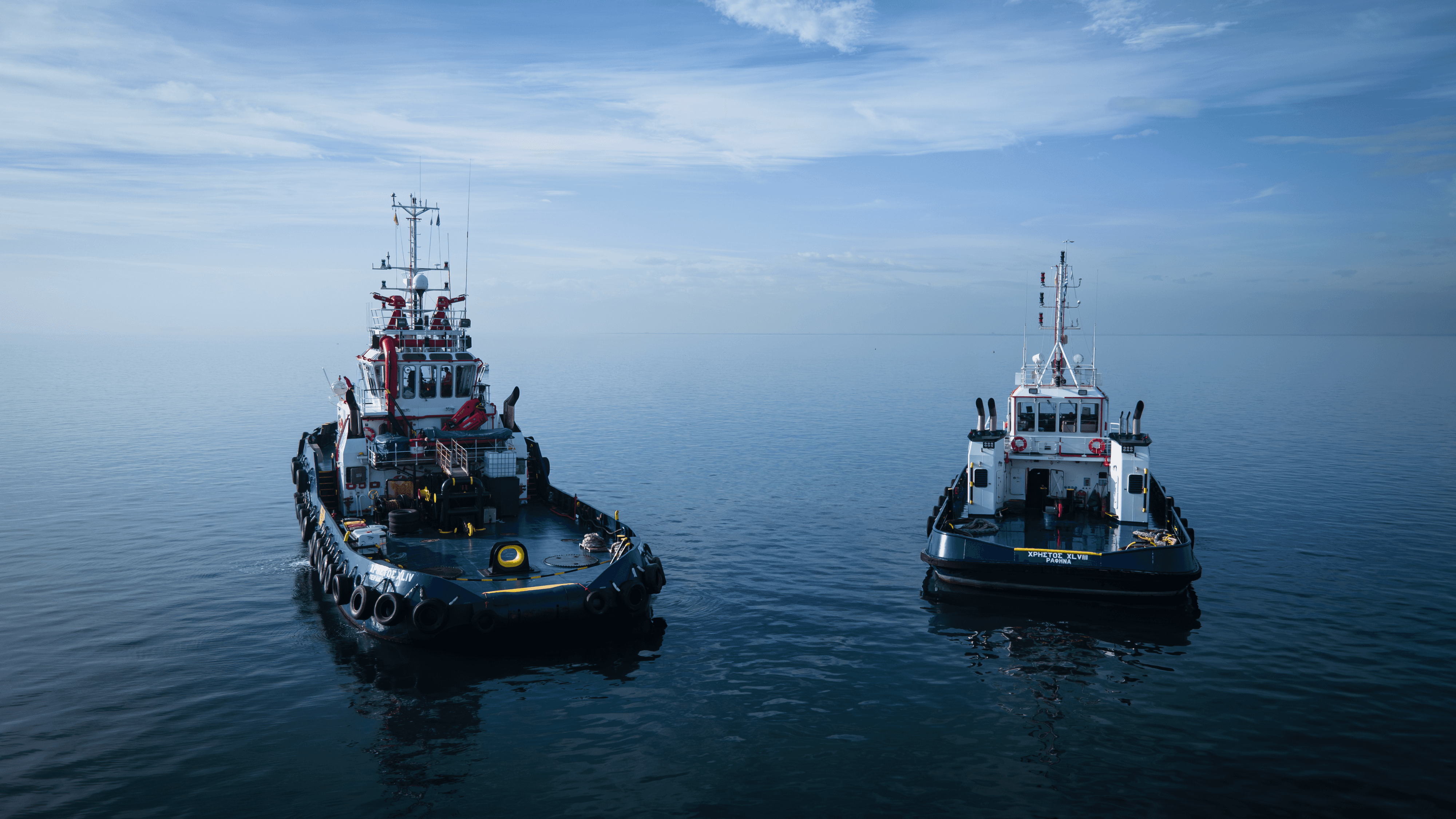
Tugboats are among the most versatile assets in a pollution response operation. Beyond their primary function, tugs equipped with containment and recovery equipment serve as the first line of response to oil spill events in Greek coastal waters. The pollution response capabilities of a suitably equipped tug include:
Deployment of floating containment booms around a spill source to limit further spread
Towing and positioning of skimmer vessels and oil recovery equipment
Transportation of response personnel, equipment, and dispersant supplies to the incident location
Stand-by positioning during bunkering operations and cargo transfer at offshore terminals
FiFi firefighting capability for simultaneous pollution and fire events
The speed with which a tug is positioned at an incident site is one of the determining factors in the effectiveness of the response. A spill contained within the first few hours causes a fraction of the environmental and commercial damage of one that spreads unchecked through the night.
IGMAR Group Environmental Response Capability
All IGMAR Towage tugboats are equipped to deploy floating containment booms and support skimmer operations. The fleet participates in annual exercises and drills in coordination with port facilities and port authorities, as required under OPRC preparedness obligations. Crews are trained and equipment is verified to perform under actual incident conditions.
IGMAR Group maintains dedicated Emergency Response Teams ready to deploy to pollution incidents and other marine environmental threats. These teams operate in direct coordination with tug crews, the operations office, and the relevant port authority, ensuring command, communication, and logistics function from the first alert to incident closure.
MARPOL Compliance for Vessel Operators
MARPOL compliance involves more than carrying the required certificates. The convention imposes equipment standards, record-keeping obligations, and discharge restrictions that vary by vessel type and the waters being transited. In Greek territorial waters and the Aegean, which fall within MARPOL Special Area designations for certain discharge categories, restrictions are stricter than those applying in open ocean waters.
Vessel operators transiting or operating in this region must ensure crew are trained, equipment is fully operational, and records are maintained to the standard required by port state control inspectors.
Oil Spill Risk in the Eastern Mediterranean
The Eastern Mediterranean carries significant structural oil spill risk. Heavy tanker traffic through the Suez Canal route, active offshore hydrocarbon exploration and production across the region, and concentrated bunkering activity at major ports all create ongoing exposure. Research consistently identifies the Eastern Mediterranean as one of the higher-risk zones globally for marine oil pollution events.
Response capability must be maintained at a level commensurate with the actual risk, not with the historical frequency of events. A spill that has not yet happened does not reduce the legal and operational obligation to be ready.
Frequently Asked Questions
What are the MARPOL requirements for tugs operating in Greek waters?
Tugs operating in Greek waters must comply with MARPOL Annex I (oil), Annex II where applicable, and Annex V (garbage). The Aegean falls within MARPOL Special Area designations for certain categories, imposing stricter discharge restrictions. Vessels must carry valid oil record books, garbage management plans, and all required pollution prevention equipment in working order.
What does the OPRC convention require from operators in Greece?
The OPRC 1990 convention requires states and operators of offshore facilities to maintain oil spill response plans, hold response equipment ready for deployment, and participate in regular exercises. For port facilities and shipping companies in Greece, OPRC obligations are embedded in the national contingency plan and port facility requirements.
How quickly can pollution response be mobilised from an IGMAR tug?
IGMAR Towage operates on a 365/24 basis with vessels positioned across Greek ports. Boom deployment and skimmer support can be mobilised rapidly from the nearest positioned vessel. Emergency Response Team deployment begins immediately upon notification.
Are IGMAR Group's capabilities relevant to oil terminals and refineries?
Yes. Oil terminals, refineries, and LNG facilities in Greece and the Eastern Mediterranean are required under OPRC to maintain spill response capability for incidents arising from their own operations. IGMAR Group's services are available to terminal operators as part of their emergency response planning.
What environmental certifications does IGMAR Group hold?
IGMAR Group's environmental management system is certified to ISO 14001:2015, administered by LRQA. The integrated SQEMS framework also covers ISO 9001:2015 and OHSAS 18001:2007. Environmental compliance is embedded in operational procedures across the fleet.
As the modern evolution of Greece's most trusted maritime legacy, IGMAR Group provides uncompromising marine pollution response support across Greek ports and the Eastern Mediterranean, with boom-equipped tugs, trained Emergency Response Teams, and ISO 14001-certified environmental management. Contact the operations team to discuss response planning, exercises, or deployment requirements.